Sunday, 7 June 2015

Slow Food South East Wales launches at St Fagans

The new Slow Food group for South East Wales (Slow Food Y De-Ddwyrain) launched in style at St Fagans yesterday (6 June), as the wider movement celebrated Slow Food Week (1-7 June).


Mark Richards, Director of Operations at National Museum Wales, welcomed everyone to the Slow Food marquee at St Fagans National History Museum (Cardiff). He noted the Museum’s research in preserving the memory of traditional Welsh food culture, exemplified by Minwel Tibbott’s role in collecting information about food from across Wales in the 1970s; the maintenance of rare animal breeds and heritage varieties (e.g. Welsh Mountain Sheep and Carlin peas) on the Museum’s farm; and how the new £26 million expansion of St Fagans will provide exhibition space for raising awareness about traditional Welsh food culture.

Slow Food South East Wales Chairperson Mark Adams spoke about the objectives of Slow Food, which include the Ark of Taste directory in support of disappearing regional foods, the promotion of small producers of foods traditional to their areas, and educating people about food production and cooking. Mark noted that the new Slow Food group was already starting activities to further a number of key Slow Food objectives.

Mark introduced Jane Hutt AM (below), the Assembly Member for the Vale of Glamorgan and Minister for Finance in the National Assembly government. She welcomed the launch of the fifth Welsh Slow Food group, saying it now gives people throughout Wales the opportunity to participate in a grassroots movement that promotes local and sustainable food production and provides a means of reaching politicians regarding local food issues. She noted several areas of Welsh Government policy that particularly coincide with the principles of Slow Food, such as the free breakfast schemes for schoolchildren (e.g. no extra sugar allowed), the Sustainable Food City initiative for Cardiff, the Well-being of Future Generations Act, and the Food Tourism Strategy Action Plan (Food Tourism being defined by the Welsh Assembly as “any activity that promotes a high-quality, distinctive, local and sustainable food experience…”). Jane Hutt concluded by commenting that, given the convergence of objectives, Wales should aim to become a Slow Food nation.


Geoff Andrews (below), author of ‘The Slow Food Story: Politics and Pleasure’ (Pluto Press, 2008), talked about the origins and history of the Slow Food movement and how its once marginal ideas have become mainstream. Members of the Cardiff, Vale & Valleys Beekeepers talked us through some basic beekeeping, while Joanne Tarling of Love Food Hate Waste gave some useful tips about reducing food waste (e.g. using left-overs and getting portion sizes right), and how this can save you money (up to £60 a month). Liz Torbin of ViVino wines of Hirwaun talked about how the company imports wine from small Spanish producers who do not use pesticides or additives in wine production.


Carol Adams, Secretary of Slow Food South East Wales, gave an introduction to the Ark of Taste. This was followed by a presented on South Wales Mountain Sheep (also called Nelson South Wales Mountain Sheep) by Glyn Davies, Secretary for this livestock breed's association. One of the first projects of the new Slow Food group is to work to get the South Wales Mountain Sheep aboard the Slow Food Ark of Taste. Although ewes of this breed are popular as cross-breeding animals, only about 25 to 30 people are involved in keeping the breed pure. Financial support for this heritage breed was recently lost from a European scheme. Ark of Taste status could help in finding alternative means of support, so the breed can continue to be traditionally farmed in its area of origin.


Around 15 local small-scale food and drink producers from South East Wales, who embrace Slow Food principles, supported the launch, and their products helped to illustrate what the Slow Food movement is all about.

Penrhiw Farm is a family-run business that produces and sells organic Welsh meat, including lambs from South Wales Mountain Sheep and the pedigree Welsh Pig that is already included in the Ark of Taste.

 
Another Welsh Ark of Taste product, artisan Caerphilly Cheese could be found on the Penylan Pantry stall, alongside other cheeses produced by small-scale producers in the South East Wales area. Alongside them, the Boragouiner Bakery (Canton, Cardiff) had soda bread and sourdough loaves, made using Welsh heritage wheat varieties, as well as Halen Môn Welsh sea salt.


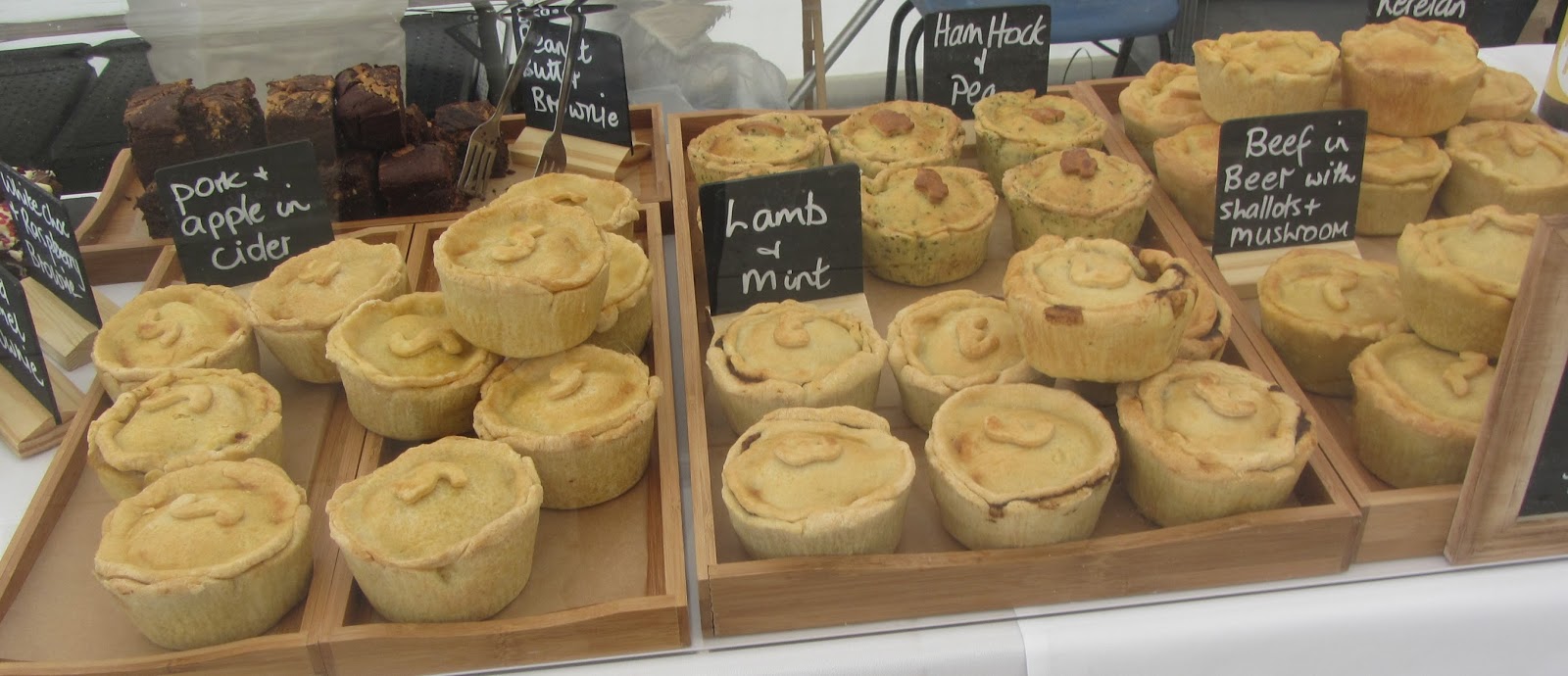
The Llantwit Major micro-brewery of Rolant Tomos and Rob Lilford (Tomos a Lilford) was representative of small-scale local beer production in the area. Coaltown coffee roasters import beans from small farms around the world. Dan Reed of Chilli of the Valley currently grows 88 varieties of chilli in a greenhouse near Merthyr Tydfil and produces a wide range of chilli sauces from them. To cool the tongue after sampling those, there was ice cream from Mari (Melin Iâ) of Penarth with innovative flavours, such as sweet fennel fudge. There were homemade jams, curds and chutneys made by Clare Williams of Penylan Preserves, and Hangfire had a range of BBQ sauces. Gluten-free pies could be snapped up from GP Uprising, raw chocolate products were available from Coco-Caravan, while Lia’s Kitchen was selling pies made using herbs from the Riverside Market Garden, an organisation that was promoting its vegetable box scheme at the event.


Nicola Lewis explained the 'reach4food directory', an initiative of the rural development programme in Bridgend, which is primarily aimed at cafes and the hospitality industry and lists local food producers and details about their produce.

With Children’s Activities, plus loud artillery bangs from the civil war re-enactment in the next field, and a wonderful atmosphere throughout the day, this was a very successful launch for Slow Food South East Wales. I’ll keep you posted as we plan our first projects, activities and other events.

Previous posts on Slow Food:
Welsh products in the Ark of Taste
http://sfnottingham.blogspot.co.uk/2015/04/welsh-products-in-ark-of-taste.html

Starting Slow Food South East Wales

 See also:
The pork at St Fagans
http://sfnottingham.blogspot.co.uk/2011/11/from-farm-to-fork-pork-at-st-fagans.html

Wednesday, 3 June 2015

Let’s Eat Insects: The Pestaurant visits Cardiff

This week (Wedn 3 June), the pop-up ‘Pestaurant’ arrived in Cardiff for the first time. Many insects were eaten by the curious shoppers on Queen Street, who learnt a bit about the benefits of entomophagy.


In a previous post (link below), I summarised some information on the widespread consumption of insects around the world, such as the UN Food and Agriculture Organisation data that shows over 2 billion people worldwide supplementing their diet with insects. It is only a novelty to eat insects in countries like the UK.

There are many benefits to consuming insects as a source of cheap protein (e.g. high protein content, low calorie food), particularly in terms of environmental impacts. For example, cattle require twelve times more feed to produce the same amount of protein as crickets, and they need way more water: 150g of beef needs 3,250 litre compared to about a pint for that amount of insect protein.

The pop-up Pestuarant is an initiative of Rentokil (“The Experts in Pest Control”). Their first Pestuarant sprang up in August 2013 in London, serving pigeon burgers as well as edible insects, such as curried crickets. They have popped-up in many places since. Cardiff’s Pestuarant was part of Rentokil’s ‘Global Pestaurant Day 2015', with around a dozen Pestuarants popping-up across the world.


Special guest at the Cardiff Pestaurant was Andrew Holcroft, founder and head chef of Grub Kitchen (“Eat insects – feed the world”). He is on a mission to promote insects as a sustainable foodstuff and to put insects on the menu in the UK. The Grub Kitchen will be opening later this year, just outside St David’s in Pembrokeshire, where it will be offering a full menu of insect dishes.

On Queen Street, Andrew served up ‘Cumin toasted crickets with wild garlic hummus’ canapes, which once you got past the initial hesitation were very good. I went back for more (photo below).

His other speciality on the day was ‘Cricket, Nutella and peanut butter cookies’. This protein-enriched cookie (5-10g protein) is made by replacing a proportion of the flour in the mix with ground cricket powder. The photo above is of Andrew serving up his cookies.


In the Grub Kitchen, Andrew is experimenting, and coming up with new edible insect dishes. So far, his signature dishes include Bug Burgers, Sago Worm Pad Thai Curry, and Cricket Kofta Kebabs. He says he is even thinking of doing a bit of insect molecular gastronomy. You never know, it could become a top foodie destination!

Andrew has to source human food grade insects from abroad, but he says he will be looking to get the proper certification to rear his own insects for the Grub Kitchen. His kitchen operates on ‘Dr Beynon's Bug Farm’, a science education and insect research centre.

Rentokil supplied a range of home-made snacks and novelty edible insect products sourced from the USA. ‘Salt & vinegar crickets’ were one of the better offerings, as the flavour enhanced a slight ‘prawny’ aftertaste (reminding you that this is not that far removed from eating crustaceans). The locusts and crickets worked reasonably well with Mexican spice and curry flavours, though I didn't rate the mealworms in any combination. Some of this would make great novelty party snack food. The plain roasted locusts and crickets were a bit bland.


Chocolate-dipped bugs, and scorpion lollipops and brittle, were at the far end of the insect as novelty food market, and were given away with Rentokil “I survived the Pestaurant challenge” badges. A little at odds with the Grub Kitchen’s promotion of edible insects as a serious food option, but it meant there was something here for everybody. Nearly everyone I saw had no problem tucking into the edible insects. I think that is a big change from the reaction such a stall would have received even a decade ago.


Introduction to eating insects:
http://sfnottingham.blogspot.co.uk/2015/05/lets-eat-insects-introduction.html

Rentokil Pestaurant page:
http://www.rentokil.co.uk/pestaurant/

Dr Benyon’s Bug Farm:
http://www.drbeynonsbugfarm.com/

Grub Kitchen – coming soon!
http://www.grubkitchen.co.uk/


Saturday, 30 May 2015

Slow Food South East Wales official launch on Sat 6 June at St Fagans

The new Slow Food group, Slow Food South East Wales (Slow Food Y De-Ddwyrain), will be holding its official launch event on Saturday 6 June at St Fagans National History Museum, from 11am to 4pm. The event will take place in The Marquee near the Abernodwydd Farmhouse at the Museum, which is located four miles west of Cardiff City Centre (just off the A4232: CF5 6XB).

The event is free and everyone is welcome to come and find out more about the Slow Food movement, and how this new local Slow Food group is championing local food producers and the traditional foods of the area. A fun day has been planned, with Slow Food and Drink producers from the area, food talks, children’s activities and more.

Slow Food is a global, grassroots organisation with supporters in over 150 countries around the world that promotes good, clean and fair food for everyone. That is, good food that is fresh, flavoursome, seasonal and part of the local culture; that is produced in a way that is not harmful to the environment, animal welfare or human health; and that is produced through fair conditions and pay for producers and accessible prices for consumers.

Local Slow Food groups work to raise people’s awareness about the food they eat and where it comes from, by supporting and promoting local food and drink producers and eateries, safeguarding endangered local foods (e.g. rare breeds and heritage vegetable varieties) and cooking traditions, and teaching the pleasure of good, clean and fair food.

At the event at St Fagans there will be a Slow Bar, stocking bottles from local producers, including craft beers from Tomos a Lilford (Llantwit Major) and wine from Spanish wine importers ViVino wines (Aberdare).

There will be around 15 food stalls, promoting a range of distinct local products and flavours. These will include a Hangfire BBQ sauce stall, the Welsh Coffee company, the Baragouiner bakery, Penylan Pantry (cheese), Trealy Farm, Penrhiw Farm (organic meat), Lia's Kitchen (pies), the Riverside Market Garden, homemade ice cream, gluten-free savoury goods, and the Cardiff beekeeping society.

A series of interesting talks throughout the event will include Geoff Andrews on his book 'The Slow Food Story', Liz Torbin on Slow Wine, Rhodri Powell on bees, Glyn Davies and Carol Adams on proposing a new Welsh product for the Slow Food Ark of Taste, and Joanne Tarling on the activities of Love Food Hate Waste.

Jane Hutt AM will be there to help open proceedings and to officially launch the new Slow Food group.

For further information on the event, contact: secretary@slowfoodssoutheastwales.org.uk

St Fagans is open 10am-5pm daily. For further information, visit the website: http://www.museumwales.ac.uk/stfagans
 
Previous posts on Slow Food:


Saturday, 16 May 2015

Let’s Eat Insects: Introduction

In addition to writing about Slow Food this year, I am here starting a new series of posts on edible insects.

According to the United Nation’s Food and Agriculture Organization (FAO), there are more than 1,900 insect species consumed as food worldwide. These edible insects are mainly beetles (order Coleoptera); butterflies and moths (Lepidoptera); bees, wasps and ants (Hymenoptera); grasshoppers and crickets (Orthoptera); termites (Isoptera); true bugs (Hemiptera); and cicadas (Homoptera). At least 250 insect species are consumed in Africa, 549 in Mexico, 180 in China, and 160 in the Mekong area. In addition, a number of insect species are eaten in Japan, especially wasps, and a few in Australia.

The FAO estimate that around 2 billion people around the world eat insects as part of their normal diet. Yde Jongema, a taxonomist of the Laboratory of Entomology of Wageningen University in the Netherlands, has compiled a comprehensive list of edible insects (see link below).

The first international conference on insects for food was held in Wageningen in May 2014, with participants from over 45 countries attending. This conference highlighted the great potential of insects for human food and animal feed. Insects have a good nutritional quality and they can provide a much cheaper source of protein, with a much lower environmental impact, than many current farming practices.

In Europe, there is much less of a tradition for eating insects (entomophagy) than in Mexico or Asia. The big challenges are raising awareness and changing perceptions, and establishing high-tech mass-rearing facilities, mainly for livestock feed and aquaculture but also to supply the increasing demand for insect protein in the human diet.

Here in Wales, we are getting out first taste of edible insects this year, through a Mexican dish that has been served in Wahaca in Cardiff, and via Grub Kitchen in Pembrokeshire.

Wahaca was founded by Thomasina Miers with the goal of bringing a more street-food orientated Mexican cuisine to the UK. Insects, sustainably farmed in Mexico and specially imported, were first served in Wahaca’s flagship Covent Garden (London) restaurant. Wahaca opened in Wales for the first time in St David’s in Cardiff city centre late last year, and one of the street food specials available earlier this year was ‘Chapulines Fundido’ - a dish made using crickets.  The crickets are fried with onions and chillies to create a brown tapenade-style paste, which is smothered with melted cheese; the dish was accompanied by corn tortillas. The crickets give this dish a nutty/smoky flavour. Its novelty value made it a popular choice, but it also helped shift perceptions about what eating insects is all about. There was no obvious insect parts on the plate, just a nutritious, flavoursome and sustainably produced protein ingredient.

There are 13 edible insect products in the Slow Food ‘Ark of Taste’. We will look at them all in another blog post. Of the 5 from Mexico, one is the Chapulines described above, and another is Chicatana flying ants. These were featured in a recent BBC Radio 4 ‘The Food Programme’ spot on Ark of Taste products. In this programme, Thomasina Miers described how the ants were collected, prepared and used in traditional Mexican dishes. There is a link to the programme below.

Grub Kitchen, near St David's in Pembrokeshire, meanwhile, is planning to serve a whole menu based on insects in its restaurant. Owner and Head Chef Andrew Holcroft is adapting and devising dishes for the British market, including bug burgers, cricket kofta kebabs, bug burritos, Mexican red Chapuline grasshoppers, and even bamboo worm fudge ice cream. Andrew is a keen advocate of insects as a sustainable source of protein, and hopes they can be mainstreamed into the British diet within 10 to 15 years. Grub Kitchen, the first UK insect restaurant, is the first step to achieving this goal.

Grub Kitchen is associated with ‘Dr Beynon's Bug Farm’, a science attraction run by entomologist Dr Sarah Beynon where edible insect dishes can be sampled. Bug Kitchen are taking their educational show on the road to festivals and schools this summer. They are also looking to ‘pop up’ to serve you a selection of edible insect dishes - I'll report on that in my next ‘Let’s Eat Insects’ posting!

Links and references:

FAO data on edible insects:
http://www.fao.org/forestry/edibleinsects/84627/en/

List of insects eaten worldwide compiled by Wageningen University (the pdf list can be downloaded here; but beware before printing - it runs to 79 pages):
http://www.wageningenur.nl/en/Expertise-Services/Chair-groups/Plant-Sciences/Laboratory-of-Entomology/Edible-insects/Worldwide-species-list.htm

BBC Radio 4 ‘The Food Programme: The Ark of Taste’: Dan Saldino talks to Thomasina Meirs about Chicatana flying ants:
http://www.bbc.co.uk/programmes/p02r7pqs

Andrew Holcroft of Grub Kitchen talks to BigHospitality:
http://www.bighospitality.co.uk/Business/UK-s-first-insect-restaurant-opening-this-summer

SlowFood posts:

Saturday, 25 April 2015

Welsh products in The Ark of Taste

The Ark of Taste is SlowFood’s catalogue of disappearing local food culture. On board The Ark are breeds of domesticated animal, cultivated plants, and artisan food products and techniques, all in need of recognition and protection to prevent them from disappearing.

Many local products and traditional production methods have suffered due to competition with cheaper, mass-produced, year-round-imported food items, such as those mainly sold in supermarkets. Farmers, producers and restaurant owners are fighting back by promoting local food systems based on heritage breeds and varieties, sustainable and seasonal production, local food sourcing and regional cuisine.

The Ark of Taste brings together small-scale, quality food production from diverse cultures and traditions worldwide. It draws attention to the existence of an extraordinary heritage of animal breeds, fruit and vegetable varieties, fish and seafood resources, cheeses, breads, and numerous artisan products, all of which are at risk of extinction within generations given present trends. Administered by the SlowFood Foundation for Biodiversity, it invites everyone to take action to help protect the items in The Ark. This can involve buying and consuming artisan products, supporting their producers, or taking part in various campaigning initiatives.

The Ark of Taste currently (25 April 2015) has 2431 products on board from all around the world (see http://www.slowfoodfoundation.com/ark).

For a taster of these, ‘The Food Programme’ on BBC Radio 4 is currently featuring stories of some Ark of Taste products (e.g. http://www.bbc.co.uk/programmes/p02pdjh9).

On board The Ark are 83 products from the UK.  These are mainly rare animal breeds (21); artisan cheeses from specific localities (10); localised fish and shellfish (10); fresh fruit and dried fruit products, including nuts (11); and vegetables (9). Also included are cured meat products, cereals and flour, baked products, spirits, pulses, seaweed (dulse) and honey. Further details of these 83 products are given on the SlowFood UK website (http://www.slowfood.org.uk/ff-products/).

There are currently 5 Welsh products (6%) among the 83 UK products in The Ark of Taste: a cheese, two animal breeds, a rare apple variety, and a seafood. The following information on these products is mainly gleaned from the SlowFood UK website:

1. Artisan Caerphilly Cheese
Traditional Caerphilly is a hard, crumbly white cheese, with a short maturation period, made using unpasteurised milk. It has long been produced by hand, on small family-run farms, as a means of using and preserving surplus milk. When sold in local markets, it was typically in the form of 5 or 10 lb truckles. From the 1830’s onwards, it became associated with Caerphilly because of its popularity among the town’s mining community.

Today, it is in competition with a very different young cheese product, also called Caerphilly, which is mass-produced using pasteurised milk and sold more cheaply in supermarkets. Traditional Caerphilly cheese is now produced by only a limited number of creameries in South Wales, such as Caws Cenarth. A small quantity of aged Caerphilly is also available from artisan producers.

2. Badger Face Welsh Mountain Sheep
The Badger Face Welsh Mountain Sheep is a low-maintenance Welsh mountain breed. It has two sub-types, both being relatively small and hardy: the Torddu (black belly) and Torwen (white belly). This breed produces milk, wool and high-quality meat having an excellent flavour. Although a very old breed, it was first officially recognised in 1976, when a small group of farmers in mid Wales, who were breeding the sheep, formed the Badger Face Welsh Mountain Sheep Society.

Pedigree flocks are relatively small and mostly kept by smallholders for their unique characteristics. They are slow to mature. Small-scale producers, such as Hebsnbadgers and Llwyn-on, are promoting it as a Slow Meat product.

3. Bardsey Island Apple
A medium-sized, sweet and juicy, pink eating apple with a unique lemon aroma, the Bardsey Island Apple is a very rare variety. The mother tree grows by a house built by Lord Newborough in the 1870’s on Bardsey Island, where it is continually ‘pruned’ by salt-laden gales.  The trees produced by grafting from it are resilient and disease-resistant, requiring no chemical spraying.

The SlowFood UK website relates how, in 1998, ornithologist Andy Clarke brought several apples from the tree to local fruit grower Ian Sturrock for identification. He, in turn, took them to the National Fruit Collection in Brogdale, where the Bardsey Island Apple was declared a new variety. The variety is grown by Ian Sturrock & Sons of Bangor and other small-scale producers in North Wales, where it has spearheaded a resurgence of interest in old and almost extinct Welsh Varieties.

4. Pedigree Welsh Pig
The Welsh Pig was first referenced in the 1870’s, and the Welsh Pig Society (formed 1922) played an important role in increasing numbers and developing its commercial characteristics. The pig is white with lop ears, a curly tail, and a long body. It is hardy and thrives in both indoor and outdoor conditions. The breed has a traditional pork flavour, and produces high-quality, well-developed hams, with a desirable ratio of meat (70%) to fat (30%). Although it has characteristics that could be of valuable to the modern pig industry, numbers have continued to decline due to competition with commercial breeds. Small producers, such as Kilvrough Welsh Pigs on the Gower, rear Pedigree Welsh Pig non-intensively.

5. Penclawdd Cockles
Penclawdd Cockles are removed from the low-tide sands of the Burry Estuary, near Swansea, by pulling a flat cart (once by donkey, now a tractor) with a metal scrape to expose them for hand-picking. A government decree in 1965 only permits licensed gatherers to take cockles, within limited quotas.  They are sold at local markets, either boiled and peeled or untreated. The cockle industry in Penclawdd has suffered due to water pollution and mismanagement of stocks, though there has been a recovery in recent years.

Many of the traditional products in The Ark of Taste have helped shape local cuisine. Protecting these products helps preserve the recipes, knowledge and history surrounding them, which may also be at risk of being lost.  This is certainly true of Penclawdd Cockles. ‘Welsh breakfast’ is a traditional local breakfast that includes cockles fried in bacon fat, laverbread and fried eggs, for instance, while the Swansea Cockle Festival is celebrated every September.

In ‘The Taste of Britain’ (2006, HarperPress), Laura Mason and Catherine Brown explored the traditional foods of Britain. The section on Wales includes further information on Caerphilly Cheese, Welsh Mountain Sheep, Penclawdd Cockles and other traditional foods closely identified with parts of Wales, including Glamorgan Sausage, Laverbread, Sewin (sea trout), Welsh Black Cattle, Aberffraw Cake, Welsh Cakes and Teisen Lap (fruit cake).

By this point, you will have realised that there is room in The Ark of Taste for many more products of the type described above, from countries all around the world, which would benefit from inclusion.

One of the many aims of the newly-established SlowFood South East Wales group (see links below) is to research and identify further Welsh products for potential inclusion in The Ark of Taste.

Previous posts on Slow Food in South East Wales:

http://sfnottingham.blogspot.co.uk/2015/03/slow-food-south-east-wales-launches.html

http://sfnottingham.blogspot.co.uk/2015/02/slow-food-in-cardiff.html

Tuesday, 31 March 2015

Slow Food South East Wales launches


New Slow Food® group launches - Slow Food South East Wales / y De-ddwyrain
A new Slow Food UK group has started in Wales: Slow Food South East Wales / y De-ddwyrain. This is the fifth group to open in Wales, with the others being in Llangollen, Dyfi Valley, Carmarthenshire and Anglesey (Dros-y-Fenai). People in South East Wales will now have an opportunity to participate in a wide range of Slow Food activities, such as meetings with guest speakers, campaigns on specific issues, awareness-raising programmes, and diverse events.

Slow Food is about helping people think differently about food. In the UK, Slow Food works to reconnect people with where their food comes from, so they can better understand the implications of the choices they make about what they put on their plates. The aim is to encourage people to choose nutritious food from sustainable and local sources, which tastes great. Slow Food is a non-profit organization, supported by members and donations.  

Mark Adams, Group Leader of Slow Food South East Wales said: “I am very happy that we have been able to form a Slow Food group in the area. These days the food market is dominated by multi-national corporations offering highly processed, multi-ingredient products as opposed to simple wholesome food. Add to this the lack of food education and we are seeing the loss of traditional cooking skills along with some of our unique native breeds.”

He adds: “Our aim in forming the group is to help people understand the impact that their choices in food can have on them, their families and the environment. We want to promote the importance of ‘local’ and help protect our culinary traditions and regional food products. Ultimately we want everyone to have access to good, clean and fair food.”

Carol Adams, founding member and Secretary of the group says: “We are a young group but have a strong committee comprising of local food and drink producers, business owners, chefs and those with an interest in good food. We are actively seeking new members to help us achieve our goals."

"We have a strong focus on food education to help individuals and communities make informed choices about their food and its production,” she explains. “Our aim is to help preserve forgotten Welsh foods and cooking traditions, alongside supporting artisan producers and farmers of sustainable and biodiverse food, which in turn helps protect the land for future generations. Our locality has an abundance of great producers and produce, and we shall be hosting a number of activities and events throughout the region.”

Slow Food South East Wales y De-ddwyrain covers an area roughly from Bridgend to the English border, sweeping up through Merthyr Tydfil and the Valleys to Monmouthshire.

The newly formed Slow Food South East Wales committee members are as follows:

Mark Adams (Group Leader/Chair), Barnaby Hibbert (Vice Chair), Rolant Tomos (Treasurer), Carol Adams (Secretary), Grady Atkins, John Thomas, Melissa Boothman, Richard Crowe, Rob Lilford, Stephen Nottingham.

For more information about the group email: info@slowfoodsoutheastwales.org.uk
Committee members
Back row from left to right: Grady Atkins, Rob Lilford, Melissa Boothman, Stephen Nottingham, Richard Crowe, Carol Adams, Rolant Tomos, and John Thomas

Front  Row: Mark Adams and Barnaby Hibbert

About Committee Members:

Mark Adams: Group Leader, Aberdare-based, Professional Trainer, Food Blogger, Food Adventure Ltd
Barnaby Hibbert: Vice Chair, Chef and Patron The Gallery Restaurant in Barry, Vale of Glamorgan
Carol Adams: Secretary, Aberdare-based, Director Food Adventure Ltd
Rolant Tomos: Micro Brewer Tomos a Lilford, Vale of Glamorgan
Rob Lilford: Micro Brewer Tomos a Lilford, Vale of Glamorgan
 
Grady Atkins: Chef and Consultant, Cardiff
 
Richard Crowe: Cardiff, avid consumer of good food and drink, a keen home cook and Welsh translator
John Thomas: Merthyr Tydfil, livestock farmer based at Penrhiw farm Trelewis. John is the fourth generation of the Thomas family to farm at Penrhiw
Stephen Nottingham: Vale of Glamorgan, freelance writer and journalist, specialising in European nature conservation, environment, climate change and food-related issues
Melissa Boothman: Cardiff, Deli Owner, The Penylan Pantry

For further information contact Carol Adams secretary@slowfoodsoutheastwales.org.uk


Wednesday, 25 February 2015

Slow Food in Cardiff

Slow Food stands in opposition to fast food. Instead of production lines of industrially-produced year-round products, Slow Food champions locally-sourced and traditional products and regional, seasonal cuisine. A revival of traditional food culture, it encourages the farming of plants and livestock characteristic of local ecosystems.

Slow Food was founded by Carlo Petrini and fellow activists in Italy, three years after a pivotal 1986 campaign against the opening of a McDonalds near Rome’s Spanish Steps. It was conceived as part of a broader ‘Slow Movement’ (see footnote). Slow Food is today a non-profit organisation operating in 150 countries worldwide. Its mission is to celebrate and protect traditional foods and cooking traditions, and to support grassroots producers of artisan and sustainable food and drink products. One of its main achievements has been the Ark of Taste, an online catalogue that gathers information about disappearing local food products (e.g. fruit and vegetable varieties, rare animal breeds, cured meat and cheeses). Anyone can send a nomination for a food product to the Ark, which this week had 2,312 products on board. 

Members within national Slow Food organisations are associated with local groups. Local groups have opened all around the UK (Slow Food UK), with Slow Food Cymru having branches in north and west Wales.

The inaugural Slow Food South East Wales meeting was held in The Cwtch at Chapter Arts Centre on Monday 23 Feb 2015. The meeting was organised by Carol Adams, Director of Food Adventure Ltd, a company much in line with the Slow Food agenda in that it takes groups on tours of local food and drink producers. I joined a diverse group of food producers, chefs, food activists and food writers/bloggers to hear three guest speakers explain what Slow Food means to them.

Margaret Rees is the Slow Food Board representative for Wales, was a founder committee member of Slow Food UK and set up the first Slow Food group in Wales, in Carmarthenshire in 2002. She described the development of Slow Food Cymru, where active branches are also centred on Anglesey and Machynlleth. She pointed out that the UK was late to join Slow Food, yet is one of the member nations where the loss of food culture is most acute. The role played by the Chef Alliance within Slow Food Cymru was noted; for example, Slow Food Cymru leader Gareth Jones is a chef and top Welsh chefs, such as Shaun Hill, are actively involved. Margaret also noted the Welsh pig and sheep breeds in the Ark of Taste. A recent development is a possible link with a Slow Food group in Patagonia.

James Swift of Trealy Farm Charcuterie in Monmouthshire spoke of how inspiring it was to attend Terra Madre. This is the International Slow Food event (organised by the international Terra Madre network of food communities), held every two years, at which small food producers, farmers and chefs from all the Slow Food nations meet and exchange experiences. It was held in Turin last year, where a 30-strong delegation from Slow Food UK attended (7 from Wales). James contrasted the UK ‘dining club’ approach unfavourably with the more dynamic contributions from other countries, which were more inclusive and political (with a small p) with campaigning being a more typical mode of operation. He noted the sense of injustice driving many Slow Food groups worldwide.  James concluded by stressing the need for better networks to link small food producers in the UK. 

The final speaker was Shane Holland, Chair of Slow Food UK, the Slow Food Board representative for England and group leader for Slow Food London. Slow Food London is an actively campaigning group that takes on an educational role in schools and crowd-funds cookery demonstrations for those with limited cooking skills. Shane believes that Slow Food UK groups should interact with the wider community, which makes them more inclusive and increases membership. A survey conducted by Slow Food London showed that events did not drive membership, but specific campaigns can, for example, on sustainable fishing, rare breeds, heritage crops, and seed saving and swapping. He noted that ‘terroir’ can be used in a wider sense, for heritage crops and animal breeds cultivated and reared in their traditional areas, and that the landscapes we value look the way they do because of food production. Therefore, the way to maintain both food culture and the environment is to support traditional, artisanal and quality food and drink production.

The speakers reiterated the Slow Food view of consumers as ‘co-producers’. Consumers through purchasing decisions can support local food products, and by taking an interest in how food is produced can also help producers by campaigning to overcome the problems they face.

Mark Adams, of Food Adventure, summed up proceedings. The interest expressed from a cross-section of people interested in local food (both producers and ‘co-producers’) suggested that a South East Wales Slow Food group could make a valuable contribution to supporting local food culture.

Slow Food (International):
http://ww.slowfood.com/

Slow Food UK:
http://www.slowfood.org.uk/

Slow Food’s European campaigning (pages 10-11):
http://ec.europa.eu/environment/life/publications/lifepublications/ngos/documents/ngo_brochure2014.pdf

Food Adventure Ltd:
http://www.foodadventure.co.uk/

Footnote
The wider Slow Movement offers a step-back from many of the accelerating or unsustainable practices of modern living (e.g. Slow Cities, Slow Finance, Slow Living, Slow Design, Slow Travel, Slow Cinema, Slow Sex…). A key text for this wider movement is Carl Honoré’s 2004 book ‘In Praise of Slow’. Slow Food has emerged as the most successful manifestation of the Slow Movement.

Saturday, 27 December 2014

We ate the reindeer on Christmas Day

We ate the reindeer on Christmas Day. Well, we ate the reindeer pâté I had bought back from Sweden. Still, the kids were shocked that we could eat Sven - Rudolph’s temporary replacement as ‘most lovable reindeer’ (Note to those without children under 12: he is the reindeer in ‘Frozen’). It was a very gamey venison pâté (that worked well alongside a milder and sweeter Ardennes pâté).


There is a reindeer farm in Wales, at Poundffald Farm on the Gower (see links below). However, they are not eaten; they earn their keep as a visitor attraction and by being hired out, for instance, to the annual Swansea Winter Wonderland. Robert Owen, the farmer, started the herd in 2006 to accompany his Christmas tree business (Gower Fresh Christmas Trees). The herd is now 19 strong and includes 12 breeding cows. In a recent Wales Online story, he describes how, in addition to grazing, he feeds them on specially-formulated food pellets and reindeer moss (the lichen Cladonia rangiferina) imported from Sweden.

In northern Sweden reindeer are herded by Sami communities, while there is also a large elk farm. Reindeer and elk are commonly eaten in Scandinavia. You can buy reindeer and elk burgers in the UK from the touring ‘Exotic Burgers’ business. This often puts down in Cardiff during the ‘Cardiff International Food Festival’. However, I encountered it last outside Tate Modern in London earlier this month. The vendor does not eat meat himself, and says he tells the burgers apart because they all look a little different when cooked (possibly due to different fat contents etc.). Here’s a photo of their Christmas menu:


The menu was a bit lighter on the deer and antelope than compared to last summer in Cardiff (when I had the springbok). I had an elk burger to see me along the wintery South Bank, where I saw ‘2001: A Space Odyssey’ again on the big screen at the BFI (the film starts with our ancestors killing antelope).

There are over 100 types of deer worldwide. Many of these are semi-domesticated in parts of their range and their meat (venison) is eaten: different deer are eaten in different countries. There are six deer species in the UK and venison in the UK could potentially come from five of these: Red deer, Fallow deer, Roe deer, Sika deer and Muntjac (you are unlikely to be eating Chinese Water Deer). Most farmed deer meat comes from the native Red deer, the largest of the UK species, with Fallow deer being the only other species farmed commercially. Consumption of venison in the UK is on the increase. In the 12 months prior to June 2014, one survey found that retail sales of venison were up over 400%.

Wales’ only reindeer herd:

http://www.welsh-reindeer.co.uk/

http://www.walesonline.co.uk/news/wales-news/they-see-one-herd-meet-8316743

We are eating more deer:

http://www.deer-management.co.uk/deer-farming-gathers-momentum-as-retail-sales-of-venison-quadruple/

Monday, 8 December 2014

The Smoke Haus and some notes on the cooking of meats

In which I ponder about burger trends and “pulled” pork, but first I eat some slow-cooked meat.

The Smoke Haus is a south Wales-based American diner. It has locations in Swansea and Cardiff (Mary Ann St, Cardiff CF10 2EN); the latter, and more-recent outlet, was the destination for our lunch for three.


I had the ‘Smoke Haus Pulled Pork Hoagie’, billed as a “smoked shoulder of pork slow-roasted for 12 hours, pulled and served in a hoagie roll with dry slaw, baby gem lettuce and apple sauce.” As with everyone on the sandwich menu, it was served with ‘slaw and skin-on fries. My companions had the ‘Slow cooked brisket deli sandwich’ (“served in toasted bloomer bread with red onion, cheese, sweet mustard, pickles and Russian sauce”) and the ‘Philly Cheese Steak’ (“pan fried wafer thin top side of beef topped with melted Emmental cheese, sweet fried onions served in a hoagie roll”). Other US-themed sandwich choices included the Reuben, the Elvis Po Boy and the Texas Link Po Bo. I rated mine the best; though it was all very tasty meat. The Smoke Haus is a very welcome addition to the Cardiff food scene.


The American influence at The Smoke Haus extends to portion size. You are likely to get served more than you can eat. The table next to us were making good use of ‘doggy bags’. You don’t have to treat it, as their website encourages, as “a challenge not for the fainthearted”. There are Brits we know living in the United States who assume they are going to get fed twice when they go into a restaurant: once at the table and again at home from the take-away left-overs (though some people apparently do feed their pets). I did eat most of my lunch at The Smoke Haus, and just demoted my next meal to a light supper.

The “challenge” at The Smoke Haus extends to the desserts. If you look past the ‘Mississippi mud pie’ and ‘Chocolate oreo sundae’ on the menu, you will see ‘The Smoke Haus Ultimate Dessert’, which comprises “a huge bowl of Vanilla ice cream, banana ice cream, marshmallows, doughnuts, chunks of pecan brownie, fresh banana topped with  squirty cream, chocolate and toffee sauce.” We passed on this.

And talking of donuts, The Smoke Haus has contributed to the growing trend for pushing the burger boundary with its ‘Donut Burger’. Admittedly, some of the buns that fast-food burgers are served in are very sweet, but the Donut Burger (as served by The Smoke Haus, though it is also served in other burger joints) takes the burger in a different direction in that the donuts are glazed and the cheeseburger patty with grilled streaky bacon is served with a sweet sauce. This breakfast, dessert or stupid burger variant, depending on how you view these things, attracted some (not unwelcome) media attention. The thick stacks of the other The Smoke Haus burgers come with (not always helpful) US-themed names, such as ‘New Orleans’, ‘Southern Comfort’ and ‘The Hog Father’.

Also in the news recently was the ‘Yorkshire Pudding Burger’, served by the north of England based Rift & Co chain, described by the Independent as just the latest in a line of “stupid burgers”. It was inspired by the Donut Burger. I am wondering where the Welsh burger needs to go from here. Should the lamb patty lie between bara brith or Welsh cakes? Incidentally, an indie burger outlet has opened in Scotland called ‘The Silly Burger’, though the burgers it serves are very sensible and down-to-earth.

The Smoke Haus menu features pulled pork and pulled lamb. The term ‘pulled’ was originally restricted to pork, to describe the process when a potentially tough cut of meat (e.g. shoulder) is slow-cooked at low temperatures so that it becomes tender enough to be pulled or easily broken into small shreds or pieces using, for example, a fork. This process can also be called shredding. Its recent prevalence on menus is due to modern US-led marketing initiatives. In addition to pork and lamb, you can now see pulled beef (i.e. shredded beef brisket), pulled chicken and pulled duck on menus. In fact, KFC have predicted that 2015 will become “the year of pulled chicken”. I suspect that other critters will soon also be “pulled” (e.g. goat and rabbit have been cooked this way for centuries). As shredded meats feature in all the world’s cuisines, the possibilities for jumping on the pulled bandwagon appear endless. However, as the innuendo element is lost when you pull anything other than your pork, I think its marketing value may have climaxed.

Christopher Hooton in The Independent on "silly burgers":  
http://www.independent.co.uk/life-style/food-and-drink/news/yorkshire-pudding-burger-is-the-latest-stupid-burger-9888177.html

Felicity Cloake on KFC and pulled chicken in The Guardian:
http://www.theguardian.com/lifeandstyle/wordofmouth/2014/sep/02/kfc-2015-year-of-pulled-chicken-seriously-fast-food
 

Saturday, 22 November 2014

European Week of Waste Reduction 2014

A blog post of two halves today, firstly with information about a European initiative to reduce food waste and then a look at how food waste is collected here in the Vale of Glamorgan (Wales).

The European Week of Waste Reduction (EWWR) starts today (22-30 Nov 2014). This initiative aims to raise awareness about sustainable resources and waste management. In particular, it encourages people, either through a group (e.g. public authority, NGO, business, educational establishment) or as individuals, to take actions to promote waste reduction. The annual EWWR was first launched in 2009 and has been co-funded by the European Commission’s LIFE+ Programme.

The EWWR’s Prevention Thematic Days 2014 focus on the issue of food waste and how to prevent it. Around one third of the food produced globally is lost or wasted, which makes no sense economically or ethically, and represents a massive loss of resources: land, water, energy and labour. Over 100 million tonnes of food are wasted annually in the EU (2014 estimate), a figure that is expected to rise if active measures are not taken.

A number of EWWR food waste factsheets can be downloaded, which cover areas such as food donation campaigns, gleaning and eco-restaurants: http://www.ewwr.eu/en/support/thematic-days-2014-stop-food-waste

The Eco-Restaurant concept, for instance, aims to optimise a restaurant’s performance in all environmental aspects, including waste prevention, reducing energy and water consumption, and reducing Greenhouse Gas Emissions. In terms of food waste, customers are encouraged to take left-over food away in paper ‘doggy bags’, customers should be offered tap water (in preference to bottled water), and more consideration should be given to different plate sizes on the menu.

The information for a Zero Waste Lunch aims to help you dramatically reduce the amount of food and packaging that ends up landfilled or incinerated. Avoiding unnecessary shopping and buying in bulk, making use of reusable bags and containers, reusing left-overs and composting food waste all contribute.


Food can be composted at home or via a local authority food waste collection scheme. Here in the Vale of Glamorgan, kitchen waste is collected weekly from the kerbside. Residents in the Vale can go along to the farm where it is processed near Cowbridge (Cowbridge Compost Ltd) and pick up some of the compost for free. We spread a load of it around when we established the Nightingale Community Garden in Dinas Powys.

The recent background paper on Waste Planning, part of the Vale of Glamorgan Local Development Plan 2011-2026, stated that the Vale handles 59,780 tonnes per annum (2012-13) of municipal solid waste, of which 5,459 tonnes per annum is food composting. It aims to increase the amount of food and garden waste being processed, and use some of it to generate bioenergy, through the creation of a new Anaerobic Digestion (AD) Treatment plant, in a joint venture with Cardiff Council.

In an announcement, unfortunately coinciding with the EWWR, the Vale of Glamorgan Council have said that it is to ration the biodegradable green bags they supply to households for food waste (Penarth Times, 20 Nov). This will make substantial annual savings, they say, because some people request unfeasibly large numbers of them. Although the local FOE group have attached the Council for this decision, it does make sense to issue a limited number of free bag rolls to households with the option of buying more.

The Vale’s kitchen waste system can seem a little overcomplicated. It involves a small caddy in the kitchen, into which biodegradable bags are inserted and a larger caddy to put roadside with the sealed bags in it. What I learnt recently is that you don’t really need the little biodegradable green bags at all, because you can just line the bigger caddy with newspaper and chuck everything straight in there. So don’t get too hung up on the little bags, just get as much kitchen waste recycled as possible!