In a previous post (15 Jan 2014), I introduced the concept
of a Nectar Point Network (NPN). The driving force for the establishment of NPN
hubs in the Cardiff area is Professor Denis Bellamy, who is the Chairman of the
Conservation Management System Consortium (CMSC) and a former head of the
Zoology Department at University College Cardiff. He has put together an informative
website on NPNs (see link below). The Cardiff NPN is taking shape through a ‘bottom
up’ approach. In an email in February, Prof Bellamy explained that, “it is
envisaged that each hub organises itself as a self-sustaining community nectar
point with its own action plan and local funding”.
The Nightingale Community Garden in Dinas Powys was
established last year, a process I outlined in a series of posts (see links
below). At the start of this year, I registered
the Community Garden as a potential Nectar Point Network hub. As a first step
into making this happen, I applied for and got an award (£100 of garden
vouchers) from Keep Wales Tidy’s Wild Weekend Voucher Application, which this
year aims to improve food sources for pollinators and is aimed at community
groups. One stipulation is that plants purchased should be on the Royal
Horticultural Society (RHS) Perfect for Pollinators Plant List.

I spent the voucher on two bee nesting boxes; five large
pots; four bags of peat-free organic compost; a bee-friendly Escallonia ‘Apple blossom’ bush; and packets
of nectar-rich plant seed, including lavender, foxglove, borage,
cornflower, marigold, marjoram and 'wild flower honey bee mix'. I intend to add a winter-flowering honeysuckle
at a later date, along with some surplus rosemary, primrose and heather from my garden. The idea is to establish a border of nectar-rich plants at one end of Nightingale
Community Garden, with five pots of bee-friendly flowers in other areas of the
garden. This will be our starting point, from which other activities will flow.

There are numerous nectar-rich plants that can be grown for
pollinating insects. The consensus is that variety is more important than focusing
on any one plant species. This is for several reasons. A range of different
species can be grown that produce nectar at different times of the year, for
instance, to feed pollinating insects active in different seasons. Furthermore,
different pollinators are adapted to different flower structures, for example,
long-faced bumblebees with long feeding parts (e.g. Bombus hortorum) are specialised to get the nectar from flowers with
long corolla, such as foxgloves. Another factor is flower colour, with
different pollinating insects homing in on different colours (e.g. Bombus
lapidarius has a fondness for yellow flowers); so the more colourful
the pollinator border the better!
A recent study, conducted by Mikhail Garbuzov and Francis Ratnieks
at the University of Sussex with 32 popular summer flowering plants over a
two-year period, identified which were the most attractive to insect
pollinators. Borage (Borago officinalis),
lavender (Lavandula) and marjoram (Origanum majorana) scored highly. However,
not all lavenders were attractive to bees, only the wild types, with
highly-bred ones such as those with novel colours not proving very attractive. Borage
flowers were the most attractive to honey bees. Perennial lamb’s ear (Stachys byzantina) was the most popular
plant with more unusual bees, such as the solitary wool-carder bee (Anthidium manicatum). The
authors concluded that choosing the plants you grow carefully can make a big
difference to pollinators. The least attractive plant in this study was the
widely-planted pelargonium.
A previous study, conducted at the University of Cambridge in
1999, of 24 plant species (not the same plants as in the Sussex study) also
revealed large differences in terms of insect pollinator visits. The most
visited plants by honey bees in this study were Malva moschata, Salvia
pratensis, Malva sylvestris, Scabiosa columbaria, Centaurea pratensis, Knautia arvensis, Trifolium repens, Salvia
verbenaca, Lythrum salicaria and Saponaria officinalis. The
bumblebee most recorded was Bombus
pascuorum, which preferred Trifolium
pratense, Salvia pratense, Trifolium repens, Laminium album and Stachys
sylvatica.
The references to both these papers are below. They
provide a good entry point into the scientific literature on this subject.
I will post more on NPNs and pollinating insects later in
the spring, along with an update on progress in the Nightingale Community
Garden as it enters its second year.
Nectar Point Network website:
https://www.sites.google.com/site/nectarpointnetwork/
Previous post on Nectar Point Networks:
http://sfnottingham.blogspot.co.uk/2014/01/nectar-point-networks.html
Previous posts on Nightingale Community Garden:
Sept 2013
http://sfnottingham.blogspot.co.uk/2013/09/creating-community-garden-10.html
June 2013
http://sfnottingham.blogspot.co.uk/2013/06/creating-community-garden-9.html
April 2013
http://sfnottingham.blogspot.co.uk/2013/04/creating-community-garden-8.html
March 2013
http://sfnottingham.blogspot.co.uk/2013/03/creating-community-garden-7.html
Feb 2013
http://sfnottingham.blogspot.co.uk/2013/02/creating-community-garden-6.html
Jan 2013
http://sfnottingham.blogspot.co.uk/2013/01/creating-community-garden-5.html
Oct 2012
http://sfnottingham.blogspot.co.uk/2012/10/creating-community-garden-4.html
Aug 2012
http://sfnottingham.blogspot.co.uk/2012/08/creating-community-garden-3.html
Feb 2012
http://sfnottingham.blogspot.co.uk/2012/02/creating-community-garden-2.html
Jan 2012
http://sfnottingham.blogspot.com/2012/01/creating-community-garden.html
References:
Livio Comba, Sarah A. Corbet, Lynn Hunt & Ben Warren
(1999), Flowers, nectar and insect visits: Evaluating British plant species for
pollinator-friendly gardens’, Annals of Botany 83: 369-383. Online: http://aob.oxfordjournals.org/content/83/4/369.full.pdf
Mikhail Garbuzov & Francis L.W. Ratnieks (2013),
Quantifying variation among garden plants in attractiveness to bees and
other flower-visiting insects’,
Functional Ecology (Oct 2013): http://onlinelibrary.wiley.com/doi/10.1111/1365-2435.12178/full
Most fruit and vegetable plants require pollination, yet the
honeybees, bumblebees, hoverflies and other insects that carry out the pollination are
having a tough time. Habitats are being degraded,
reducing the number of nectar-rich plants in built-up areas; while disease, varroa
mite and insecticides have taken their toll on honeybee numbers.
The situation can be improved by individuals planting
nectar-rich plant species for feeding insects on an ad hoc basis. However, an
initiative to improve insect pollination services through public participation
has just been launched: the Nectar Point Network.
A nectar point is a location that has been augmented with
plants that produce nectar for insects. It could be in a community garden, residential
garden, school grounds, park, roadside verge, or even a large window-box. A
nectar point network is a coordinated series of such nectar points in a given
area. The network rests on a group of local activists in a growers hub, such as
a community garden, who use their skills and resources to propagate nectar-rich
plants to supply to their neighbours.
The main considerations in establishing nectar points are to
select nectar-rich plants to grow in soil or containers, and to keep a record
of the outcomes of planting and any monitoring of pollinators that is done. There
is therefore an element of citizen science involved in nectar point networks,
with participants encouraged to learn about different pollinator species (e.g.,
bumblebees) and to communicate their
findings to other groups (e.g., via websites and blogs).
Networks of nectar points can be planned to create ecological corridors through built-up areas for pollinating insects, and to generally enhance local biodiversity and wildlife in gardens and streets. Networks can also, of course, encompass apiaries, and the strategic location of bee tubes or hotels for solitary bees species.
Here are some bee-friendly plants for gardens: heathers, rosemary,
dead nettles, pussy willow, thyme, cotoneaster, wallflower, sage, honeysuckle,
comfrey, cornflower, buddleia, delphinium, hollyhock, and lavender.
The Nectar Point Network website suggests several local actions for
groups. ‘Linking with Lavender’ is one example of a
neighbourhood growing scheme with the objective of establishing nectar-rich plants for pollinators in an urban setting. It relies on a local community garden acting
as a hub for propagating and distributing plants in pots to its
neighbours. The pots can be returned to
the hub annually or purchased. Costs
could be met by local sponsorship. The pots, containing lavender or any other
nectar-rich plants, can be used on patios or paved front garden.
A Welsh Government draft Action Plan for Pollinating Insects
was launched in July 2013 (see below), in recognition of the major economic importance of natural pollination services. Also, a new Welsh Government initiative
called Cynefin (meaning ‘habitat’) aims to help individuals and groups
throughout Wales mount community-led environmental action plans. Cynefin
Cardiff is already working with four community gardens in Cardiff with a view
to starting a city-wide Nectar Point Network.
This should be the first of a series of posts on Nectar
Point Networks on this blog, as I help get a network hub started here in Dinas
Powys. I will report on what is involved, and write more about schemes to
improve the pollination of fruit and vegetable plants, during the year.
Nectar Point Network website:
https://www.sites.google.com/site/nectarpointnetwork/home
Nightingale Community Garden, Dinas Powys:
http://sfnottingham.blogspot.co.uk/2013/09/creating-community-garden-10.html
Welsh Government Action Plan for Pollinators (links to draft
documents here):
http://wales.gov.uk/topics/environmentcountryside/consmanagement/conservationbiodiversity/action-plan-for-pollinators/?lang=en
Friends of the Earth ‘The Bee Cause’ campaign:
http://www.foe.co.uk/bees
Cardiff Market, also known as Cardiff Central Market and
Cardiff Indoor Market, opened in 1891. It was designed by William Harpur and
consists of a large wrought iron shed running from the back of the Market
Buildings on St Mary Street through to Trinity Street.
There are currently seven butchers (around the outer walls),
six fruit & vegetable stalls, several bread and cake retailers, along with
a fishmonger, a cheese stall, and imported food and spice stalls. There are
also seven cafés and snack bars. If you want fresh local produce in Cardiff
from independent retailers, look no further. You also know that you will be
buying from stallholders who have expert knowledge of their subject and
produce. It is difficult to do all the food stalls in Cardiff Market justice here, but I offer this as an introductory guide to the market.

The present layout divides the Market into 265 units; though
these are typically occupied as units of 2 or 4 by today’s larger stalls (originally
there were 349 stalls). On the ground floor there are around 60 businesses
arranged along both side walls and on both sides of four aisles, while an
upstairs balcony that runs all around the building houses around 10 businesses.
Each of the three central areas between the aisles is split into three blocks. The
Manager’s office (2087 1214) is in the clock tower at the centre of the
building. The market is open 8.00am to 5.30pm Monday to Saturday.
On this Walking Tour of Cardiff, we enter Cardiff Market
from Trinity Street (though the main postal address for the market is St Mary
Street where the other main entrance is located). There are two stalls in the
Trinity Street entrance hall. To your left:
E. Ashton (Fishmongers)
200 Cardiff Central Market CF10 1AU (2022 9201)
This fishmonger’s stall has been here since the market first
opened in 1891. It was originally owned by the Adams family. The Ashton family
have been selling fish for five generations, originally from a shop in Penarth
and since the 1950s from this stall in Cardiff Market. Ashton’s sell a large
variety of fish and shellfish on their marble slabs, including fish species you
don’t often see. There’s also rabbit, poultry and a range of more unusual meats.
This morning I bought some Welsh bass, which is currently being promoted. This
stall is part of Ashton’s large local business operation, which supplies many
restaurants in the region with fish and shellfish (Food Hygiene Rating 2:
improvement necessary. July 2013).
Opposite:
Seymore Fruit and Vegetables
197-201 Cardiff Central Market CF10 1AU
Although called ‘Sullivan’s Fruit & Veg’ over the stall,
this fresh fruit and vegetable stall is currently owned by M. Seymore, who also
operates another stall in the Market (138-142). Lively sales banter and seasonal
bargains are the order of the day.
Go through the inner doors, past the stairs on both sides to
the gallery. Turn right to the stalls on the outer edge:
The Celtic Corner
41-43a Cardiff Market CF10 1AU
This café in the corner, owned by C. Carroll, has seating across
the aisle (unit 93) and is always busy when I’m in Cardiff Market. Apparently, ‘Bovril
is back’ (Food Hygiene Rating 4: good. Jan 2013).
Continue down this far side, past pots and pans, tools and
wool:
A&S Griffiths
19 and 21 Central Market CF10 1AU (2039 7669)
A&S Griffiths (also known as A.W. Griffiths) Butcher and
Danish Bacon Specialists. Also has a stall on the opposite side of the market (18-20
and 22-24), both locations selling a range of meat and poultry, including Welsh
lamb, burgers, hams and faggots (Food Hygiene Rating 3: generally satisfactory.
Sept 2013).
Perkins and Sons
15 and 17 Central Market CF10 1AU (2022 4494)
Also known as R.T. Perkins butcher. Range of meats, again
with a focus on local produce (Food Hygiene Rating 5: very good. June 2013).
You can exit the market here via a side door that takes you
toward Church Street.
Walk around the bottom end of the first aisle, past all the
wigs, and start walking up the second aisle. On your right at the end, at the
start of the central row of stalls opposite the entrance to St Mary Street:
The Market Munch Box
145 and 148 Central Market CF10 1AU
Take-away serving coffee/teas, sandwiches and hot baguettes.
Today’s specials included roast pork, stuffing and apple sauce filled baguettes
and bologna pasta (Food Hygiene Rating 4: good. Oct 2013).
On your left:
The Continental
49, 51, 99 and 101 Central Market CF10 1AU
This snack bar and take-away lunch was formerly called Cose Cosi (Food Hygiene Rating 1: major improvement necessary.
June 2013).
Fresh and Simple (Market Deli)
53, 55, 57, 59, 103, 105, 107 and 109 Central Market CF10
1AU (2034 5165)
Fresh fruit and vegetables counters on both sides at the end
of this first block of stalls, including a section of more exotic fruit and
vegetables (Food Hygiene Rating 5: very good. Oct 2011).
The other side of the aisle, at the end of this first block
of stalls:
The Bread Stall
155-156 and 158 Cardiff Market CF10 1AU (2022 6941)
Fresh bread (cobs and bloomers), sandwiches, Welsh cakes, and
other cakes (Food Hygiene Rating 4: good. Feb 2013).
On the very central block of the ground floor:
Cardiff Bakestones
163 and 165 Cardiff Market CF10 1AU
Welsh cakes and offer traditional cakes freshly-cooked on their large bakestone
(Food Hygiene Rating 5: very good. June 2013).
At the end of this central block, which is underneath the
clock tower:
Clancy’s
167 and 170 Central Market CF10 1AU
Clancy’s is a recent addition to Cardiff Market, opening in
Jan 2013. Impressive range of chilli peppers and spices in glass jars,
alongside herbs. Vegetarian and vegan street-food and cakes, including halloumi
and spicy snacks; today’s special is lentil daal.
Mark’s Foods
171, 169, 174, 172 Central Market CF10 1AU
This ‘world food stall’ established in 2009 moved to this
bigger location (from the stall now occupied by Clancy’s) about a year ago. It
sells a wide range of imported foodstuffs, including olives, sundried-tomatoes,
vine leaves, nuts, berries and dried fruit, alongside Mediterranean sweets
(e.g., Turkish delight and licorice) and honey-drenched baklavas.
Opposite the Trinity Street entrance:
Yeates Confectionary
179 and 182 Central Market CF10 1AU
Yeates Confectionary, formerly R. Litton, sells pick-and-mix
sweets (Food Hygiene Rating 5: very good. Jan 2012).
Walk down the third and final aisle, from the Trinity Street
end:
The Cheese Stall
94, 96, 144 and 146 Central Market CF10 1AU (2066 6603)
Cheese and Deli stall owned by K. Kemble, selling a good
range of Welsh cheeses, and is also a sandwich shop. Eggs for sale.
M. Seymore
138, 140 and 142 Central Market CF10 1AU (2038 2020)
Fruit and vegetables.
At the end of this first block:
Coffee Central
82, 84, 132, 134 and 136 Central Market CF10 1AU
Formerly Jazzy Jackets, this is a modern-looking take-away
for coffee/teas and snacks (Food Hygiene Rating 5: very good. June 2013).
Judy Griffin
76, 78, 80, 126, 128, 130 Central Market CF10 1AU
Judy Griffin’s fruit and vegetables stall, which may be
operated by Yeates (Food Hygiene Rating 5: very good. Oct 2011).
Yeates
60, 62, 74, 110 and 112 Central Market CF10 1AU
M. Yeates sell a wide range fruit and vegetables, including
exotic fruits. In fact, Cardiff Market is generally the first stop for fruit
and veg that are a little out of the ordinary (Food Hygiene Rating 5: very
good. Oct 2011).
Market Deli
54, 56, 58, 104, 106 and 108 Central Market CF10 1AU (2066
6603)
Range of delicatessen produce, including hams and corned
beef, pies and pasties, Scotch eggs (Food Hygiene Rating 5: very good. June
2013).
Turn at the St Mary Street end and come back down the fourth
and final aisle. On the outer side:
K. Blackmore & Sons
Stalls 2, 4 and 6 Central Market CF10 1AU (2039 0401)
Someone was ordering three whole pig heads when I walked
past this morning. Great hunks of steak, also venison, wild rabbit and a range
of marinated meats, such as goat curry, Greek-style lamb shanks, Singapore
chicken, spicy pork and one just labelled ‘bloody hot’ (Food Hygiene Rating 3:
generally satisfactory. Oct 2010).
Market Deli
8, 10 and 12 Central Market CF10 1AU
Range of meats produces including sausages, across the aisle
from the other Market Deli stall location. Indian and other ready meals are
made at this stall (Food Hygiene Rating 5: very good. June 2013).
Along the outer row of stalls:
Gary Anthony
14 and 16 Central Market CF10 1AU (2038 7900)
Butcher. Gary Anthony also has a stall on the opposite side
of the market. Good range of meats on offer (Food Hygiene Rating 4: good. June
2013).
A&S Griffiths
18, 20, 22 and 24 Central Market CF10 1AU (2039 7669)
Also known as A.W. Griffiths. Butcher with good range of
hams, bacon and other meats (Food Hygiene Rating 2: improvement necessary. Sept
2013).
A. Morgan
26 and 28 Central Market CF10 1AU
Also known as A.J. Morgan: Butcher (Food Hygiene Rating 3:
generally satisfactory. March 2011).
Gary Anthony
30, 32 and 34 Central Market CF10 1AU (2038 7900)
Another traditional butcher with excellent range of produce
(Food Hygiene Rating 4: good. June 2013).
J. T. Morgan
36, 38, 40, 42, 44 and 46 Central Market CF10 1AU
(2038 8434)
Butcher, focussing more on pre-packed meat products (Food Hygiene
Rating 4: good. Jan 2013).
Take the steps up to the balcony by the Trinity Street
entrance. Once you are facing into the market, go around anti-clockwise, past
the toy shop, aquarium suppliers and electrical goods stalls to:
Woody’s
237, 239 and 241 The Balcony, Central Market CF10 1AU
Woody’s Café has seats along the balcony and in the unit
next to the counter. Breakfast and lunches, mainly burgers and other fry-ups. A
giant panda walks along the balcony edge (Food Hygiene Rating 2: improvement
necessary. June 2013).
Around past The Pet Supermarket, and between the two sets of
stairs down to the St Mary Street entrance:
The Gallery Café
213, 215 and 217 The Balcony, Central Market CF10 1AU
The Gallery Café, with Donnelly’s Café on the signage,
serves breakfast and lunch, including burgers, hot dogs and pies. Seating along
the balcony and in a unit by the counter (Food Hygiene Rating 3: generally
satisfactory. June 2013).
Keep walking around, past the life-size plastic Elvis
Presley (he’s still for sale):
Kelly’s Records
212-232 The Balcony, Central Market CF10 1AU (2037 7355)
This record business, established in 1969 by Ed Kelly and
still in the family, is a terrific place to browse through second-hand vinyl,
CDs and DVDs. Kelly’s Barbers is within
this block of stalls (218, 220).
Next door:
The Bull Terrier Café
234, 236, 238, 240, 242 and 244 The Balcony, Central Market
CF10 1AU
This is the largest café in the market, with seating on both
sides of the counter and along the balcony. Big on breakfasts (as are all the
market cafés). Lunches include faggots, chips, and a range of other snacks and
fry-ups. Today’s specials included roast pork and turkey, chicken curry, and
meatballs on pasta (Food Hygiene Rating 4: good. June 2013).
Carry on past Petworld, go down the stairs, and exit to
Trinity Street.
The Kitchen Cabinet is a Radio 4 panel show about food
presented by Jay Rayner. Each week, the programme travels round the country. Last
night it was being recorded in Cardiff, at The Gate Arts & Community Centre.
I went along to find out more about this popular radio show, which completes
its fifth season with the Cardiff episode.
The four panel members for this programme were local
representative Angela Gray, from the Cookery School at Llanerch vineyard in the
Vale of Glamorgan; the Cambridge-based food writer Tim Hayward; the chef and
cookery teacher Angela Malik; and Peter Barham, a food scientist from the
University of Bristol.
The panel lined up on a stage set up for The Gate’s annual
Christmas production of Aladdin, and this was very much the programme’s
Christmas episode. Therefore, it was a bit of a missed opportunity to focus on
Welsh food, although bara brith and the Welsh-Italian connection featured as
key parts of the discussion.
On arriving, all audience members were asked to answer
questions (e.g.,'What is your culinary Christmas wish?’) and write down a
question for the panel. Recently, we ate Haggis Pizza at a St Andrew’s Night
event at the Murchfield Community Hall in Dinas Powys. This inspired my
question to the panel: ‘Is there a limit to what can be put on a pizza base?’
Among the other audience members who put questions to the panel was Cardiff’s
Ed Gilbert (aka @gourmetgorro). Alternative Christmas meals, cocktails, and
cooking with coca cola were among the topics raised.
The recording was efficient and audience involvement was
central to the show. The contribution by Angela Gray and an Italian restaurant owner
on Italian food in Wales was particularly interesting; Angela Malik proposed
some intriguing Asian twists to traditional Christmas classics; Tim Hayward’s had
useful tips on baking and the use of rhubarb in drinks; and Peter Barham
provided scientific context and had to field the trickiest questions like ‘is
there a cooking gene?’. No, is the resounding answer to that question, by the
way.
To find out more, I recommend you tune in next Tuesday 17
December (3pm) or over the following week on the BBC website:
http://www.bbc.co.uk/programmes/b03lph1b
Jay Rayner is a genial host, who gets the panel to explain
culinary terms so no audience member is left behind. It’s the inverse of the recent
food panel show with experts displaying their erudite knowledge of obscure food
items. I believe that ran for one series, whereas The Kitchen Panel could
potentially have the longevity of a show it liberally borrows from – Gardeners’
Question Time.
I thank Dan Allsobrook (aka @eggynewydd) for taking this photo of
me and Jay Rayner:
Morgan Arcade was opened in 1896. It was originally known as
the New Central Arcade. Today, it is owned by Helical Bar, who also own the
Royal Arcade. This is one of Cardiff’s beautiful series of Victorian arcades,
which are home to many independent local businesses.
Walking up The Hayes, from our previous walking tour destination
the Royal Arcade, enter the first entrance to Morgan Arcade, between Moss
Brothers and Moulton & Brown. On the left is a plaque with some history
about David Morgan, after whom the arcade is named:
Further along on the left is Tabernacle Lane, which links
the Royal and Morgan Arcades (collectively, the Morgan Quarter). By Capital
second-hand bookstore, the three sections of Morgan Arcade join, with one
pushing through to St Mary Street. At this junction:
The Plan
28-29 Morgan Arcade, Cardiff CF10 1AF (2039 8764)
The Plan Café Bar has been running in this prime Morgan
Arcade location since 2002. The owner is David Nottingham (no relation). There
are tables downstairs and upstairs and they serve breakfast and lunch, locally-made
cakes, and the café is fully licensed. The Plan is particularly noted for its
specialist coffees and, to a slightly lesser extent, teas. It has been listed
among the ‘Top 50 Coffee shops in the UK’ in The Independent and in a similar
Top 50 list in The Guardian. Head Barista Trevor Hyam, who started working at
The Plan in 2007, writes a specialist blog on coffee called ‘The Bean Vagrant’;
he came fourth in the 2010 UK Barista Championships; he experiments with brew
methods using his Mahlkonig Tanzania grinder; and he sources craft-roasted
traceable coffee beans. In other words, he knows his stuff. You can explore a
range of single estate coffees on the specialist menu, with recent coffees on
the menu coming from estates in Kenya, Rwanda, Ethiopia, Guatemala, Bolivia,
Columbia and Costa Rica.

The stretch of the arcade along to St Mary Street has no
food outlets, but there are many interesting shops, including Bang &
Olufsen, (quality Danish sound systems – no MP3 players), Fountain Fine Arts (where
you can buy affordable art by Welsh artists), an Oxfam clothes shop, the Camera
Centre, and Neal’s Yard Remedies.
Entering the second arm of the Morgan Arcade that connects
back to The Hayes, on the other side of The Plan, is Spillers Records (31 Morgan
Arcade). Spillers Records was established in 1894 by Henry Spiller. The shop
moved to its current location in 2010, from its previous location by the The
Hayes entrance to Morgan Arcade.
Jam, Marmalade, Bread, Hot Chocolate, Cream, The Sweet,
Meatloaf, Tangerine Dream. Now those were the days - when bands named themselves
after food!
Next to Spillers:
Crumbs
33 Morgan Arcade CF10 1AF (2039 5007)
Crumbs is Cardiff’s oldest vegetarian restaurant. It was
opened on 3 Dec 1970 by Judi Ashley, at a time when most people had not heard
of brown rice. Crumbs came under new
ownership earlier this year. I believe the new owner is called Paul. It has
been spruced up, with new tables and décor, and rebranded as Crumbs Vegetarian
Kitchen and Coffee Shop, but the original ethos has been preserved. Large bowls
of salad are still a main feature and servings are still generous, though
possibly not as huge as in the olden days and prices have gone up. I had the
large mixed standard salad bowl last week, which as before, comprised layers of
different salads (six on this occasion) in a wooden bowl, with grated carrot,
shredding cabbage, apple and brown rice. There was plenty of cheese on top,
though the amount of brown rice was less than I remember. Crumbs also do
breakfast, soups, jacket potatoes and other lunches, and have good bread. It is
essentially the same healthy food as served since 1970: it was reassuring to
know that Crumbs is still Crumbs. They do take-away. There are two small rooms
upstairs, so Crumbs is bigger than it looks from the outside.

Royal Arcade opened in 1858 and is the oldest surviving
arcade in Cardiff. It was designed and built by James & Price, for the
Cardiff Arcade Company, and connects The Hayes to St Mary Street.
W
e enter the Royal Arcade from The Hayes, with Dr
Martens (boots) and Scribbler (greeting cards of dubious taste) on your left-hand
side and Rossiters (Bath-based designer department store) to your right. Second
on the left, though you’ll have to walk a few units to find the door:
Wally's Delicatessen and Wally's Kaffeehaus
38-46 Royal Arcade CF10 1AE (2022 9265)
This family-run delicatessen, currently owned by Steven
Salamon, has been a feature of the Royal Arcade since 1981. The deli has
expanded considerably since it first opened and stocks around 1,600 products
from around the world. It’s great for those unusual ingredients and foods
imported from continental Europe. In
2011, Wally’s Kaffeehaus opened upstairs. This Viennese-style coffee house
specializes in Open Sandwiches, such as the Tyrol (roast chicken breast,
chorizo, shaved manchego cheese, Piquillo peppers, garlic mayonnaise, rocket,
black olives and toasted sourdough) and the Baden (German smoked black ham,
Hereford Hop cheese, chutney, balsamic onions and sliced pear, on wholegrain
seeded bread). Vegetarian options include the Rohrbach (Grilled aubergine and
Caerphilly cheese). The Aufschnitt comprise sharing platters of cold meats or
cheeses. The menu draws on the deli produce downstairs, so if you particularly
like something chances are you can buy it on the way out.
Fresh
32 Royal Arcade CF10 1AE (2022 3158)
Fresh Baguette opened in 2000 and has established itself as
one of the most popular independent sandwich shops in Cardiff. Gareth Lawton
and his partner Samantha make good use of Twitter to promote the business, with
daily specials often posted in the morning (@freshbaguette1). Yesterday’s was Falafel
and Humous Baguette with salad and toasted cumin seeds. My most recent involved
chicken, bacon, mayo, rocket, red onion and salami cracking. Easily the most
creative sandwich-makers in the city; they are not afraid to be experimental, with
novel ingredient combinations and spicy sauces. Regulars can also work through
the 100-plus regular fillings for baguette and paninis on the menu. Service is
friendly and efficient. Expect to see a queue outside at lunchtimes.
The alley across the way, Tabernacle Lane, links Royal
Arcade with Morgan Arcade.
Vom Fass
28-30 Royal Arcade CF10 1AE (2022 9497)
Vom Fass Cardiff sells oils, vinegars and spirits from barrels.
The cupcake shop Velvet Ice (formerly 20 Royal Arcade),
which opened in 2011, has closed. Has the inexplicable (to me) fashion for
cupcakes peaked?
Further along this southern side of the arcade, there is a Health
with Herbs (24 Royal Arcade).
I intended to take lunch in Harleys Coffee Shop (8 Royal Arcade)
when my walking tour made it to the Royal Arcade. But, alas, this
long-established coffee shop closed earlier this year after 13 years of trading in the arcade.
This side of the arcade also has a new Oxfam book shop, with
vinyl records upstairs. At the entrance from St Mary Street, there’s a sign of
the times: an electronic cigarette shop.
Cross to the other side of the arcade, which currently
starts with a seasonal Christmas shop.
Royal Sweet Shop
7 Royal Arcade CF10 1AE (2038 7438)
Traditional newsagent with rows of those tall jars of old-fashioned
sweets.
There are no further food-related units in Royal Arcade.
However, of note along this side of the arcade is the very wonderful stationary
and art supply shop Pen and Paper (where our eldest daughter has a Saturday job).
Further along, by the entrance to Tabernacle Lane, is the Ian
Allen bookstore and model shop (31 Royal Arcade), specializing in books on
transport.
The display featuring muddy carrots is not
something you usually see in a hotel restaurant. Another clue as to what’s
occurring are the shelves of Hugh Fearnley-Whittingstall books. We are in Zest, the
restaurant at Cardiff Marriott, to sample the new menu created in partnership
with River Cottage.
People increasingly like to know where their food comes from
and how it is produced. In responding to diners’ interest in the provenance of
their food, Zest has teamed up with Fearnley-Whittingstall’s River Cottage: an
organization built around locally-sourced, ethically and
sustainably produced, seasonal food.
Cardiff is one of
only two Marriott Hotels to trial the partnership. If successful, it will be
rolled out to more of Marriott’s other 50 UK hotels. The goals the partnership has set are ambitious ones.
For the menu, Marriott is committing to increase the use of local food, produced within a 60 mile
radius of the hotel, to 80%. In Cardiff, Marriott is lucky. There is a wealth of Welsh food producers to
choose from. The produce sourced for the menu so far includes meat from Graig
Farm and Slade Farm, fish and shellfish from Gower Coast Seafood and E. Ashton,
eggs from Farmhouse Freedom Eggs, cheese and dairy products from Calon Wen and
Abergavenny Fine Foods, and vegetables from the Welsh Box Scheme and Ty Mawr Organic.
Because the menu is seasonal,
the menu will change frequently. Daily changes are expected, so even regulars
will find something different to order.
The amount of food
wastage in the catering industry generally can be pretty shocking. Marriott’s
are here committing to further reducing food wastage from their current low
level of 5%.
By improving sustainability
practices, Marriott’s hopes to improve its Sustainable Restaurant Association
(SRA) rating in the two hotels trialling the partnership with River Cottage.
All the meat and vegetables on the menu will be organic, with the chicken also being free-range, and the fish and shellfish sustainably-sourced.
The partnership has involved staff from Marriott Cardiff
taking part in training courses at River Cottage’s recently launched Chefs’ School, to
acquire new skills relating to sustainable food procurement and other areas
that complement their catering industry expertise.
On the table, the rosemary bread was very fresh, and there was a sprig of
rosemary on the table (impossible not to pinch and smell). We started with ‘Parsley
Salad’ and ‘Squash & Goat Cheese Salad’. Parsley was a feature of my salad,
but the main interest was the crab meat, accompanying soft-boiled egg, and the
intense anchovies hidden underneath. Crisp thin-sliced beetroot was the
unannounced star of the other colourful salad.
For Mains, I opted for ‘Slow Cooked Organic Graig Farm
Brisket’, served with anchovy and rosemary potato gratin and red wine sauce; the
meat melted in the mouth.
My partner had the ‘Slade Farm Lamb’, with mashed celeriac, chilli and thyme.
The lamb had a subtle barbeque flavour.
The other vegetables, ordered as sides,
were ‘Honey Glazed Carrots’ and ‘Kale, Chilli and Fennel Seeds’. The carrots
had a wonderful intense flavour and looked great – orange, white and purple.
The fennel on the kale produced a sensational effect, though the chilli was a
little heavy for our taste in this context.
With sides this was not ‘small plate’, but rather ‘three
good things on a plate’ (the title of one of Hugh’s books).
I’m afraid that for the ample puddings we opted for exotic
options, with some ingredients what were probably not grown around Cardiff. My ‘Sticky
Date Pudding’ came with homemade vanilla ice cream, and my partner’s ‘Almond
and Orange Pudding’ came with a slice of pear cooked in red wine as well as the
ice cream. However, a warm beetroot brownie, and apple and cherry crumble with
custard, were also on the menu.
Local wine and beers are available, although they were not
listed on the main wine and drinks menu. We had a bottle of Glyndwr 2012, a
medium dry white wine produced on a vineyard established in 1982 by the Norris
family in Llanbleddian, near Cowbridge, in the heart of the Vale of Glamorgan.
Generally, the local and seasonal approach can help produce
a coherent menu, where fresh food items are used in different ways throughout
to create a satisfying dining experience that also celebrates and supports
local growers and artisan producers.
Zest actively encourages locals to join hotel guests in
their dining room.
Marriott Cardiff:
http://www.marriott.co.uk
River Cottage:
http://www.rivercottage.net
All food and drink consumed was kindly provided by Marriott Cardiff.
I was on a journalism assignment recently in Hungary,
writing about an EU LIFE-funded soil monitoring project. As part of the trip, I
went to the Tokaji wine-growing area in the north-east of the country, which
has been a UNESCO World Heritage Site since 2002. As well as looking at the
soil monitoring system in operation, I was also fortunate enough to have a private
tour and tasting in the historic Konyves cellar.
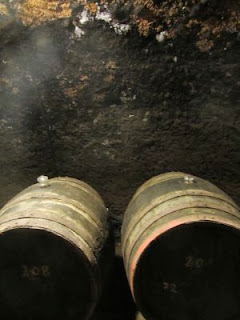
The tour takes you through the labyrinth of cellar tunnels
cut into the soft volcanic rock of the hillside. There are over 700 m of cellar
at Konyves, filled with around 800 oak barrels. The walls are covered with a
mould (Cladosporium cellare), which
is white when young but grows into a thick black layer. The mould feeds off the
alcohol vapours from the barrels. It is important, because it regulates the
humidity (88-95%) and temperature (a constant 12°C) in the cellar.
Three wines of increasing sweetness are usually tasted on
these tours. The first is Furmint, a very dry and unremarkable white wine made
from the Furmint grape variety. The second is a Muscadet, from the French grape
of that name (the only one of the half-dozen Tokaji grape varieties that does
not originate in Hungary), which is here really to give a taste of a standard sweet
wine. The star is saved to last – the distinctive Azsú (bottle pictured). This
is the sweetest naturally-made wine, with 70% sugar. The sweetness is complex,
however, with honey, tropical fruit (citrus/apricot) and nutty flavour notes. It’s
nectar.

The grapes that give Azsú its character come from the
Furmint vines, but they are infected with the fungal mould Botrytis cinerea. This concentrates the grape’s sugar content and
flavour. I was in the vineyard in early October and the grapes (photograph) are
still growing – the shrivelled brown Azsú grapes are hand-picked in early
November from the Furmint bunches. It’s like making wine with juicy raisins.
The bottle is labelled ‘5 puttonyes’, which traditionally referred to the
number of buckets of Azsú grapes added to 130 litres of must in a barrel (the
range is from 3 up to a very sweet 6); now it refers to the sugar level. The wine is
aged for 3-6 years in the barrel.
Out in the vineyard, we saw some curious
pipes in the ground. The nearest one in this picture is 12 metres above the
wine tasting area in the corner of the cellar, which is carved out of the hillside
below the vineyard.
The conditions are not right to make the Azsú every year, just one in every two or three years; in
those years they make a lot of Furmint. They have kept samples from all the
Azsú years back to 1895 in the Konyves cellar. It’s a stroll back in time.
I would like to thank Miklós Dombos, of the Institute for
Soil Sciences and Agricultural Chemistry in Budapest, and György Zsigrai, of
the Research Institute for Viticulture and Oenology in Tokaj, for arranging the
visit to the cellar.
LIFE website - funding environmental and nature conservation projects
in the European Union:
http://ec.europa.eu/environment/life/
In a series of posts I
have outlined the process by which Nightingale Community Garden in Dinas Powys was
created (links below). In June, I described how the garden was flourishing
during its first summer. Among the verdant greenery, it was hard to believe
that gardening had only started a couple of months previously. Some of the crops were entered in
this year’s Dinas Powys Village Show (31 August); Giles Metcalf’s beetroot, for
instance, won First Prize.
On Saturday 14
September, the official opening of the Nightingale Community Garden was held. Cllr.
Keith Hatton and Elizabeth Millard, of the Dinas Powys Residents’ Group, welcomed
everyone, outlined the history of the garden, introduced the special guests,
and thanked those who had made important contributions along the way.
Keith had the original
idea of doing something with the derelict piece of land, on the footpath that
connects Sir Ivor Place and Nightingale Place, which was becoming a focus for
anti-social behaviour in the area. With Elizabeth, they put together the first
plan for turning it into a Community Garden. At an early stage they gained the
support of Mike Ingram, one of the special guests at the event, who is the
Operational Manager of Public
Housing Services at the Vale of Glamorgan Council. Mike facilitated the smooth
transition of the site, from unwanted public housing land to Community Garden.
The Finance Minister
of the Welsh Assembly Government Jane Hutt AM placed the garden within the
larger context of The Rural Development Plan, which is a joint Welsh Government
and European Union strategy. In her short speech, she stressed the importance
of finance from the European Agricultural Fund for Rural Development, which
along with Welsh Government funding enables projects such as this to happen.
Jane also stressed the importance of supporting community-led initiatives.
The Welsh Government
funds community projects through Councils. Cllr. Liz Burnett, another of the
special guests at the event, is Vale of Glamorgan Cabinet Member for
Regeneration, Innovation, Planning and Transportation. The money that comes to
the Council for rural regeneration is in her portfolio. The Vale of Glamorgan Council
funds its own rural development initiative: Creative Rural Communities.

Rob McGhee of the
Community Foodie section of Creative Rural Communities, established to help
communities grow their own food, has been involved with the Nightingale
Community Garden project from a very early stage. He has been key in obtaining funding
and helping to manage the project, including overseeing the
contractors who have worked to transform the site. He praised the enthusiasm of
the local communities he works with, both in Dinas Powys and in other places
were similar projects have been successful such as Treoes. Rob is the one talking in the picture above, with Mike Ingram next to him.
BBC Wales’ weatherman Derek
Brockway (above, with Keith) certainly bought the sun with him, which shone throughout proceedings.
With a cheery “hello and shw’mae” he gave us an up-to-date weather forecast.
Unfortunately, this involved windy autumn weather just around the corner. He noted
how the warmest and driest summer for seven years had helped the garden be so
productive in its first year. Below is a picture of Derek cutting the ribbon,
with Keith looking on. Derek took time out from filming his current series of
'Weatherman Walking' for BBC Wales to open the Community Garden. You can find
details on the BBC website, where you can also print out Weatherman Walking maps that enable you to follow in Derek's footsteps. He
was right about the weather today (Sunday); though I am in the warm writing
this, and he is walking and filmed up in the bleak Brecon Beacons!
Here’s a photo of
Cllr. Keith Hatton, Derek Brockway, Elizabeth Millard and Jane Hutt AM.
During the speeches
Keith and Elizabeth thanked several people whose energy and enthusiasm have
contributed enormously to the garden’s success. We owe a big debt of gratitude
to Stuart Hockley for, among other things, orchestrating the laying out of the
plots and for erecting two large greenhouses and a shed in the garden. Merry
Metcalf was thanked for organizing all the paperwork during the crucial stage when
the plots were being allocated, and Lynne Squires was thanking for carrying on
in this role.

Angela Peterken is the
lead gardener of a Family Growing Group within the garden. This arose from her
work as a Learning Support Assistant at Dinas Powys Infants School, following
enquiries by parents keen to start growing vegetables with their children. Five
families have been working alongside each other on the largest plot in the
garden, including families with no previous experience of growing their own
food. 24 different types of vegetables have been grown on their plot, including these
pumpkins (a credible Third Prize in the Village Show), which are being lined up
for Halloween.
An impressive array of
food was on offer, all contributed by plot-holders, including a cake made by
Angela. David Southall, who was thanked by Keith during the speeches for
donating the large greenhouse to the garden, is seen here cutting the cake,
with Mike Ingram and Elizabeth Millard looking on.
Below is a picture of Robin
Harrison at the plant stall, selling seeds and seedlings. Robin is a fount of gardening knowledge and he teaches an Organic
Gardening course at Murchfield Community Centre on Wednesday mornings (10am-12
noon) during term-time; part of Penarth Community Learning Centre’s adult
education programme.
Below are some photos
taken during July and August, since my last dispatch on the Community Garden,
including one of the small wooden seats Giles made from felled timber and one
of my own plot. Like many plot-holders, I had good crops of runner beans,
potatoes and courgettes; along with rhubarb, peas and chard. As Elizabeth said, at
the conclusion of the speeches, this is the fulfilment of a dream to turn an ugly
derelict area into an attractive productive garden, which has really bought
together the community in this part of Dinas Powys.
Previous posts on
creating a Community Garden in Dinas Powys:
June 2013
http://sfnottingham.blogspot.co.uk/2013/06/creating-community-garden-9.html
April 2013
http://sfnottingham.blogspot.co.uk/2013/04/creating-community-garden-8.html
March 2013
http://sfnottingham.blogspot.co.uk/2013/03/creating-community-garden-7.html
Feb 2013
http://sfnottingham.blogspot.co.uk/2013/02/creating-community-garden-6.html
Jan 2013
http://sfnottingham.blogspot.co.uk/2013/01/creating-community-garden-5.html
Oct 2012
http://sfnottingham.blogspot.co.uk/2012/10/creating-community-garden-4.html
Aug 2012
http://sfnottingham.blogspot.co.uk/2012/08/creating-community-garden-3.html
Feb 2012
http://sfnottingham.blogspot.co.uk/2012/02/creating-community-garden-2.html
Jan 2012
http://sfnottingham.blogspot.com/2012/01/creating-community-garden.html


